CA of the Future Competency Framework
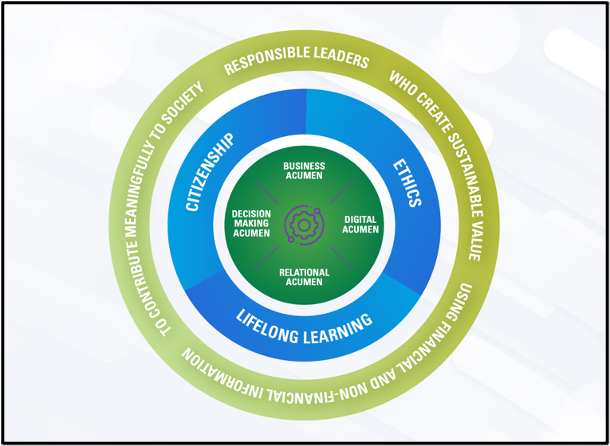
The CA of the Future is defined as a responsible leader who behaves ethically, creates sustainable value, and uses integrated thinking to make impactful decisions that contribute meaningfully to society. The SAICA CA of the Future Competency Framework suite of documents guides the core components of the qualification process (academic and professional programme / education, assessments and practical work experience) in developing the required competencies required to becoming designated as a CA(SA). The Competency Framework document repository consists of:
A. The CA of the Future Preface
B. At Entry “CA of the Future” Competency Framework;
B(a). Appendix 1. Detailed competencies setting out the learning outcomes for the Professional Values Attitudes and Acumens (PVAAs) and the Technical competencies at point of entry
C. Guidance on the Content, Development and Assessment of Competencies in the Academic Programme;
D. Guidance on the Content, Development and Assessment of Competencies in the SAICA Training Programme;
E. Guidance on the Initial Assessment of Competence (IAC); and
F. Guidance on the Professional Programme and the Assessment of Professional Competence (APC).
The CA of the Future Document Repository
A. Competency Framework Preface
- Professional Values & Attitudes: A deep commitment to personal and business ethics, good citizenship, and a mindset of lifelong learning. This includes Ethics values and attitudes; Citizenship values and attitudes and Lifelong learning values and attitudes
- Enabling Competencies (Acumens): The essential "human" and future-focused skills required to become a CA(SA). Enabling competencies demonstrate the essential knowledge and skills that influence ways that CAs(SA) work, ways that they think and tools that they use in the workplace. This includes Digital Acumen (like data analytics and cyber security), Relational Acumen (teamwork and communication), Decision-Making Acumen (critical thinking), and Business Acumen.
- Technical Competencies: Technical competence is defined as the ability to apply specific technical knowledge to solve problems in the value creation process. Solving these problems requires the integration of the Professional Values and Attitudes and/or Enabling competencies to perform a role to a defined standard. Technical competencies in the value creation process are categorized into six competency areas:
- Strategy and governance to create sustainable value
- Stewardship of capitals: Business processes and risk management
- Decision-making to increase, decrease or transform capitals
- Reporting on value creation
- Tax Governance and Compliance
- Assurance and related service
- Professional Values & Attitudes: A deep commitment to personal and business ethics, good citizenship, and a mindset of lifelong learning. This includes Ethics values and attitudes; Citizenship values and attitudes and Lifelong learning values and attitudes
- Enabling Competencies (Acumens): The essential "human" and future-focused skills required to become a CA(SA). Enabling competencies demonstrate the essential knowledge and skills that influence ways that CAs(SA) work, ways that they think and tools that they use in the workplace. This includes Digital Acumen (like data analytics and cyber security), Relational Acumen (teamwork and communication), Decision-Making Acumen (critical thinking), and Business Acumen.
- Technical Competencies: Technical competence is defined as the ability to apply specific technical knowledge to solve problems in the value creation process. Solving these problems requires the integration of the Professional Values and Attitudes and/or Enabling competencies to perform a role to a defined standard. Technical competencies in the value creation process are categorized into six competency areas:
- Strategy and governance to create sustainable value
- Stewardship of capitals: Business processes and risk management
- Decision-making to increase, decrease or transform capitals
- Reporting on value creation
- Tax Governance and Compliance
- Assurance and related service
Download the full document for further guidance:
B. Entry-Level Competency Framework
What is this document? Identifies and describes the professional competencies (professional values and attitudes, enabling competencies and technical competencies) that a CA(SA) should demonstrate at point of entry to the profession (as developed in the underlying core components of the programme);
This main document that contains the descriptors for each competency area and sub-group at entry to the profession. It must be read in conjunction with appendix 1 which contains the learning outcomes and proficiency level for each of the competencies.
The Core Message:
CAs(SA) are able to enter into a wide range of different roles and occupations post registering as a CA(SA) and the underlying qualification process is designed to prepare CAs(SA), who undertake relevant an ongoing continuous profession development (CPD), to enter a wide range of roles within business and the public sector
The competency framework provides a reference point for current and prospective CAs, employers and the public, thus enabling a clear understanding of the foundational professional competencies the CA is able to demonstrate as he/she embarks upon their career. The competency framework also provides the base upon which the education, training, professional and assessment programmes of SAICA are developed and delivered.
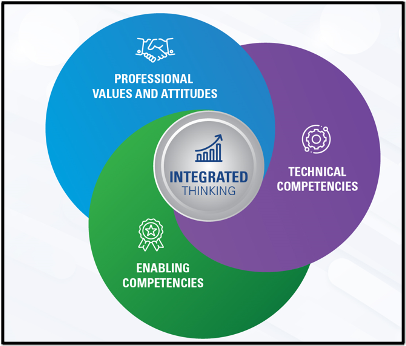
CAs need to integrate all relevant competencies (professional values and attitudes, enabling competencies (acumens) and technical competencies) to provide quality deliverables (inputs, services, products and experiences) on a wide range of inputs, activities and outputs that lead to outcomes in an organisation’s value creation process. This requires integrated thinking (also presented as an enabling competency below) to achieve viable solutions while considering all alternatives, by obtaining a broader understanding of an issue, creating a design or formulating a plan, etc.
The three competency types, namely Professional Values and Attitudes; Enabling competencies (acumens); and Technical competencies in the value creation process can be depicted as follows:
The competency types cannot be developed or assessed in isolation and indeed it is where these competency types overlap that thinking in an integrated manner is achieved.
This document must be read together with Appendix 1 (retained in Excel format due to complexity and cross-referencing) is the single source for the detailed learning outcomes and proficiency levels across the Professional Values and Attitudes (PVA), Enabling, and Technical Competencies. It shows the progression of the At Entry Competency Outcomes and proficiency levels and the levels and outcomes across the Academic, Training, and Professional Programmes.
Download the full document for further guidance:
C. The Academic Programme: Your University Foundation
What is this document? The objective of this document is to equip providers of the Academic Programme with guidance for the development and implementation of the SAICA Competency Framework in the SAICA endorsed academic programmes. SAICA is not prescriptive as to the curriculum and method of development of the competencies in the Academic Programme, however a guideline for the minimum content per competency area is presented in Appendix 1 of the Competency Framework. This is merely a guide or a tool to reach the required cognitive outcomes and level.
The Core Message: The Academic Programme is formal competency based education. It includes a three or four-year undergraduate programme which is registered as a level 7 qualification on the NQF and the postgraduate programme which is registered at a level 8 qualification on the NQF (applying the HEQSF).
Academic programmes are delivered by public universities and private providers (referred to as academic programme providers) and are endorsed by SAICA (in addition to the required statutory accreditation requirements set out by the Council for Higher Education and the Department of Higher Education and Training).
These programmes should as a minimum develop all the competencies set out in the CA(SA) Competency Framework CA of the Future Appendix 1. The academic programme is responsible for achieving coverage (depth and breadth) of the competencies required to be developed in the academic programme at the proficiency level documented in the Academic Guidance column. Core minimum content is outlined Appendix 1 PVAA and Technical Competencies and constitutes the competency areas that must be addressed by public universities and private providers in offering the academic programmes.
The academic programme should include an element of general education; developing the PVAA’s as well as develop a strong technical foundation (which serves as a base to achieve the development of CAs(SA)). The goal is not just to prepare students to pass exams, but to develop graduate attributes like critical thinking, research skills, and problem-solving. Universities are encouraged to focus on foundational and intermediate concepts relevant to the South African economy, rather than forcing students to rote-learn the rules of highly complex, specialised industries (like cryptocurrency or aerospace).
Download the full document for further guidance:
D. The Training Programme: Real-World Experience
What is this document? This outlines the expectations for a trainee's formal period of practical workplace experience (done through a formal training contract of at least three years) undertaken at an approved training office and where competencies developed throughout the academic programme are further developed and assessed ‘on-the-job’. (Note that some trainees complete the training programme concurrently with the academic programme and therefore undertake a four or five-year training contract period.)
The Core Message: The training programme provides a professional environment and a formalised period of practical work experience in which aspiring CAs(SA) –
- Can develop and demonstrate the appropriate Professional Values and Attitudes (PVAs) and Enabling Competencies (Acumens) (collectively referred to as PVAAs) in practical, real-life situations; while
- Gaining experience in the technical competencies (term used in the context of the training programme is “functional competencies”) (technical work completed in the various operating and functional units of an organisation) through integration within, between and across each area in the value creation chain (inputs, business processes and outputs leading to outcomes); and
- Developing progressive levels of responsibility and proficiency while under appropriate levels of supervision.
While trainees gain exposure to technical tasks during the training programme, the focus is on developing the "PVAAs"—your Professional Values, Attitudes, and Acumens. The PVAAs will be formally assessed during the training programme. This will be done within the context of the functional (technical) competencies dependant on each trainee’s working environment.
Download the full document for further guidance:
E. The Initial Assessment of Competence (IAC):
What is this document? The IAC is a standard setting exam, which aims to assess core competence at the end of the academic programme and is a key component of the qualification model.
The purpose of this document is to outline the high-level principles that govern the assessment. It is intended to provide broad context for stakeholders.
The Core Message: The purpose of the IAC is to set out illustratively through multi-disciplinary case studies, the core competencies and standard to which the competencies are to be developed in the academic programme.
The Initial Assessment of Competence (IAC) is a cornerstone of the professional qualification pathway, serving as the required standard-setting examination upon the completion of the academic programme (after completion of a SAICA endorsed PGDA programme), and as a stepping stone to complete the full qualification journey, including the Assessment of Professional competence.
This assessment signals to academic programme providers the required standard to which the competencies should be developed and assessed in the academic programme. This includes technical competencies as well as the assessment of some of the professional values and attitudes (primarily ethics) and enabling competencies (primarily communication, decision making and business acumens).
The IAC is set independently of accredited Academic Programme Providers and is therefore used to evaluate (measure) the standard and quality of the academic programme. It serves as an important measure of accountability of accredited Academic Programme Providers (together with the monitoring and accreditation of the academic programme)
Download the full document for further guidance:
F. The Professional Programme & APC
What is this document? The document provides guidance and development in the context of the Professional Programme. It further provides the high level principles which govern the Assessment of Professional Competence (APC).
It is intended to provide broad context for stakeholders
The Core Message:
The path to qualifying as a Chartered Accountant (SA) is a rigorous process of professional development and assessment achieved across various components including the Academic Programme, the IAC and the Training Proramme. This final stage comprises two distinct but interconnected components: the Professional Programme (PP) and the Assessment of Professional Competence (APC).
Together, these components serve as the bridge between the theoretical knowledge acquired in the academic programme (and assessed via the Initial Assessment of Competence - IAC) and the practical application required of a professional entering the workforce.
The Professional Programme: The Professional Programme serves as a bridging programme for all candidates who have completed the IAC, regardless of the training environment. The objectives of the Professional Programme is to
- Perform at higher levels of learning by requiring them to engage in analysis, synthesis and evaluation of past learning and apply it to new scenarios and experiences;
- Integrate principles, theories, and methods learned throughout their previous learning experiences and creatively analyse, synthesize, and evaluate learned knowledge with a professional focus;
- Communicate effectively at a professional entry level;
- Further develop the PVAAs in real-world, open-ended scenarios; and
The APC is the second part of the qualifying examination (QE) and a prerequisite for registration as a CA(SA). It assesses professional competence (professional values and attitudes, enabling and technical competencies) at the level expected of a competent CA(SA) at the point of entry into the profession. However, success in the APC is predicated on the skills developed during the Professional Programme and the training contract.
Download the full document for further guidance: